Technological Breakthroughs Facilitating Smooth Live Poker Operations in Online Card Rooms
Written by Sam Hughes · Jun 5, 2026

Technological Breakthroughs Facilitating Smooth Live Poker Operations in Online Card Rooms
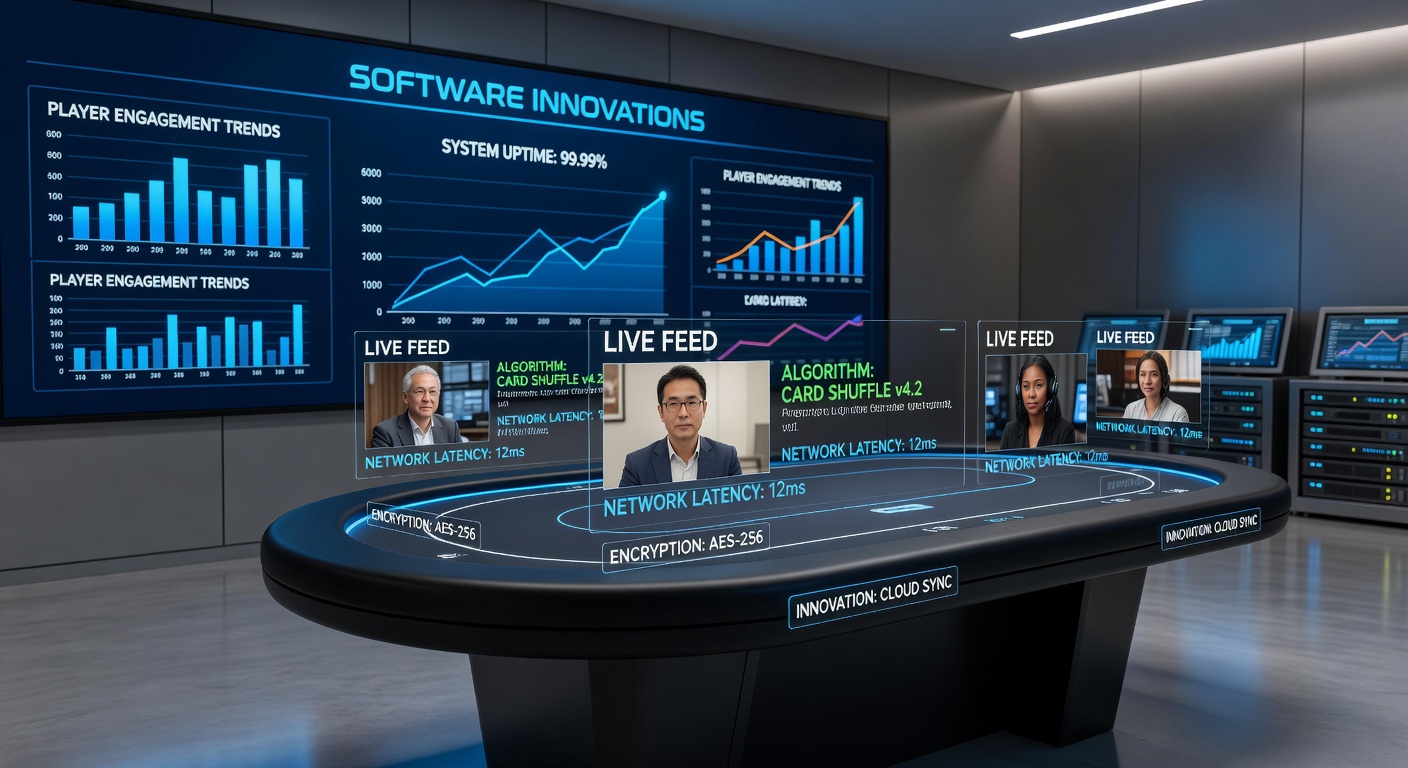
Software systems powering live poker in digital environments rely on layered architectures that coordinate video feeds, player inputs, and dealer actions across global networks. These frameworks handle synchronization challenges by distributing processing tasks among edge servers located near user clusters, which reduces transmission delays to under 200 milliseconds in optimal conditions. Developers integrate protocols such as WebRTC for peer-assisted streaming while maintaining centralized control through custom middleware that validates every action against game rules before updating shared tables.Real-Time Data Synchronization Mechanisms
Engineers employ distributed ledger elements alongside traditional databases to log card shuffles and bets instantaneously, ensuring all participants see identical states regardless of geographic location. Data shows that packet loss compensation algorithms, drawn from telecommunications research, reconstruct missing frames without interrupting gameplay flow. In practice one system deployed across multiple jurisdictions uses predictive modeling to anticipate network hiccups and pre-buffer dealer movements accordingly.
Video Processing and Multi-Camera Integration
Live dealer tables utilize arrays of high-definition cameras whose outputs merge through computer vision pipelines that track chip stacks and card orientations automatically. Software stitches these angles into a cohesive view while applying compression techniques that preserve detail at varying bandwidth levels. Observers note how June 2026 updates introduced adaptive bitrate switching that maintains 60 frames per second even during peak traffic periods reported by industry monitoring services.
Security Layers and Fraud Detection
Encryption standards combined with behavioral analytics form the backbone of anti-collusion measures, scanning for irregular betting patterns across sessions. According to figures from the New Jersey Division of Gaming Enforcement, automated systems flagged over 12,000 suspicious sequences in the preceding fiscal year through machine learning models trained on historical transaction data. These tools operate in parallel with human oversight teams that receive prioritized alerts when thresholds are crossed.
Scalability Through Cloud Orchestration
Containerized microservices allow platforms to spin up additional table instances within seconds during high-demand windows such as major tournament series. Load balancers distribute traffic using algorithms refined by university studies on distributed computing, preventing bottlenecks that once caused table freezes. Research indicates that elastic resource allocation has enabled operators to support simultaneous participation from more than 50,000 users without degradation in response times.
Player Interface and Accessibility Features
Front-end applications render dynamic table layouts that adjust to device capabilities, incorporating touch gestures and keyboard shortcuts for rapid decision entry. Accessibility modules provide screen-reader compatibility and customizable color schemes that meet regulatory guidelines established by bodies including the Australian Communications and Media Authority. Users connect through progressive web apps that cache essential assets locally, allowing continued interaction during brief connectivity interruptions.
Integration With Regulatory Compliance Tools
Automated reporting modules generate audit trails that satisfy requirements from diverse oversight entities across regions. These systems timestamp every transaction and export structured data sets compatible with external review platforms. A report issued by the European Gaming and Betting Association highlighted how standardized APIs have streamlined cross-border verification processes for operators managing live poker offerings.
Conclusion
Collectively these innovations create environments where live poker proceeds with minimal friction between physical dealer actions and digital representations. Continued refinement of underlying codebases promises further reductions in latency and expanded feature sets as hardware capabilities advance through 2026 and beyond.